
The 30 greatest international teams of all time

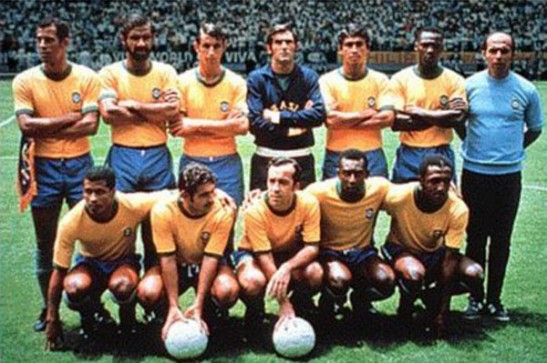
Brazil team of 1970

"The greatest expression football as art": Brazil 1970

5. Italy 1934-38

Points: 304

Only the passing of decades and the identification with Il Duce have ensured this team isn’t as celebrated as it should be outside Italy. But then Vittorio Pozzo’s side accumulated records that Benito Mussolini couldn’t but trumpet: most of all, they became the first of just two teams to retain the World Cup. In between they also won Olympic gold while losing only three games over five years.

As such, it was inevitable that the Fascists would fixate on such success to promote their supposed superiority. But Italian football was already on the up before the Black Shirts came to power. And, in truth, the only deeper link between the state and the team was in the style of management. Although a liberal-monarchist himself, Pozzo presided over the side like a dictator. Adopting a “semi-militaristic approach to the game”, as the book Calcio puts it, Pozzo claimed he “never lost sight of my players, not even for a minute”.

The result was a team that was super-fit and physical… but not without a large degree of fantasy. Because Pozzo also enjoyed one of the most gifted ever Italian generations. With the squad founded on a Juventus core that had won five successive scudetto, it was finished off by two of the greatest forwards in Italian history. Giuseppe Meazza and Silvio Piola are two of only three Italians to have scored more than 200 goals in Serie A. But, other than their outstanding ability, that was about all they had in common. Meazza was Italian football’s first true superstar, Piola an antidivo who didn’t drink and shunned fine.

For the national team, however, they complemented each other perfectly. Many said that about the conditions and the squad as a whole as they won that first World Cup in their own country. But they banished all doubts by doing it again in France four years later.

Tournament record: 1934 World Cup winners, 1938 winners
Manager: Vittorio Pozzo
Best XI: Combi; Monzeglio, Allemandi; Ferraris, Monti, Bertolini; Guaita, Meazza, Piola, Ferrari, Orsi


4. France 1998-2001

Points: 318

As David Trezeguet thundered the ball into the Italian net to win Euro 2000, Dider Deschamps later admitted to stopping in the centre circle and thinking “it’s never going to get any better than this”. Certainly, very few will ever surpass it. France’s run of winning the World Cup, the continental championship and the Confederations Cup in quick succession remains unmatched in Europe. Along the way, they also only lost two competitive games while layering sheer quality onto cast-iron resolve.

It was the latter they most needed to start the cycle though. It’s astonishing now to think how disregarded the French team were ahead of the 1998 World Cup. But Aime Jacquet rallied the team to eventually drive to the trophy with the meanest defence the World Cup has ever seen.

As often happens with such besieged sides, that maiden conquest gave them the confidence to take things to the next level. But France didn’t just jump up. They made a quantum leap.

Euro 2000 has since gone down as one of the great tournaments given the exquisite attacking football on show. And no-one defined that more than its champions. With the team centred around Zinedine Zidane in a 4-5-1 formation before it became fashionable, France produced all manner of magnificent angles. Indeed, in a rare instance of arrogance the week before the final, Zidane even admitted that “at 28, I’m at the pinnacle of my art”.

But France still needed craft to take them over the line. Sylvain Wiltord’s 93rd-minute equaliser in the final emphasised both their resources and their resolve. As Roger Lemerre said afterwards, “it is the willpower of the team that did it… the miracle happened and we caused it.” One of his deputies backed this up: “Zidane is merely a vital ingredient in the social chemistry of a squad whose members relish their closeness so much it seems as though as individuals they belong to a club called France.”

Typically, it was when that unravelled in the build-up to 2002 that France did too. For a time though, it was difficult to see how Deschamps could possibly be wrong.

Tournament record: 1998 World Cup win, Euro 2000 win, 2001 Confederations Cup win
Manager: Aime Jacquet, Roger Lemerre
Best XI: Barthez; Thuram, Lizerazu, Blanc, Desailly; Deschamps, Vieira; Henry, Zidane, Djourkaeff; Trezeguet


3. Brazil 1958-62

Points: 319

Perfection required a path to be laid. And the Brazil side of 1958 broke the mould in more ways than one. Aside from winning that long-desired first World Cup, the 4-2-4 formation they pioneered blew away football and almost everyone that came up against it.

In 1958, for example, they had won both the semi-final and final 5-2 against France and Sweden respectively. “There was no doubt this time,” as Brian Glanville wrote in his history of the tournament, “that the best, immeasurably the finest, team had won.”

Aside from a collective, however, they were also gifted some of the greatest talents the game has ever seen. Most famously, a 17-year-old Pele proclaimed his pedigree in 1958. But, even when he got injured in Chile four years later, Garrincha only took his performance to greater heights. It led Benfica’s great manager Bela Guttmann to remark that “tactics are for everybody… but they are not valid for him.”

Many opposition sides found that the same applied to the team as a whole.

All that really keeps them behind Spain and their own successors in 1970 are the two draws that punctured otherwise perfect World Cups as well as the fact they couldn’t claim a South American championship. As such, they may not have been perfect. But they were certainly on the way there.

Tournament record: 1958 World Cup win, 1959 (March) South American championship runner-up, 1959 (December) South American championship third place, 1962 World Cup win
Manager: Vicente Feola, Aymore Moreira
Best XI: Gilmar; Djalma Santos, Nilton Santos, Bellini; Zito, Orlando; Garrincha, Didi, Vava, Pele, Zagallo


2. Spain 2007-10

Points: 325

In some eyes, the small margins of Spain’s four successive 1-0 wins on the way to the 2010 World Cup took the gloss off their glory. But that’s probably looking at things from the wrong perspective.

Because it shouldn’t be forgotten that they euphorically waltzed their way to the European Championships with some wondrous football two years prior. Indeed, the exact quality of the football caught many teams by surprise. Built on a core of players from Barcelona’s youth system, Spain had a club-style cohesion that no modern international side could hope to match.

Just like Barca, they controlled the ball with their passing and then controlled the space with their pressing. Indeed, no international team has ever utterly dominated individual matches in the manner Spain did. And, given that they did that in every game they played, it is no surprise that it was reflected on a grander scale. Between 2007 and the end of the World Cup, Spain produced the most relentless sequence in international history: they won an emphatic 49 games out of 54 (91%) while only losing twice.

But it all meant that, by the start of the South African World Cup, most teams knew it was suicide to go toe to toe with Spain. As such, they echoed Jose Mourinho at Inter and blocked up as much space around their own goal as possible.

“What did people think?” Xavi asked on the eve of the final. “That we were going to win every game 3-0? I can’t believe what I am hearing sometimes. Do you not realise how hard it is? Teams aren’t stupid. We’re European champions, they all pressure like wolves. There isn’t a single metre, not a second on the pitch. Always 10 men behind the ball putting pressure on.”

The effect ensured a tournament performance that was in stark contrast to the abandon of the Euros. Spain passed and passed and passed until some people passed out… but, ultimately, they found away.

The only blip, and a bare one at that, was the reversal to the USA in the Confederations Cup semi-finals. It is that smallest of margins, by contrast, that keeps them off the top. But possibly only temporarily. Because they still have the core squad, the consistency and the quality to make it a unique treble in Euro 2012.

Tournament record: Euro 2008 winners, 2009 Confederations Cup semi-finals, 2010 World Cup winners
Manager: Luis Aragones, Vicente Del Bosque
Best XI: Casillas; Ramos, Capdevila, Puyol, Pique; Busquets, Xavi, Iniesta, David Silva; Torres, Villa


1. Brazil 1970-73

Points: 326

Gerson would concede no ground. “Our team was the best. Those who saw it, saw it. Those who didn’t will never see it again.”

What they missed was perfection. Seven wins from seven and the most irresistible attack the World Cup has ever seen in both stats and style. Brilliant individuals produced individual moments of brilliance that will forever remain burned on football’s collective memory: Carlos Alberto’s ball for Jairzinho against England, Rivelino’s free-kick, Tostao’s technique… But crescendo fittingly came in Carlos Alberto’s eight-man team goal. Or, as so many have said in the time since, “the highest expression of football as art”.

“Those last minutes,” Hugh McIlvanney wrote in his match report, “contained a distillation of their football, its beauty and elan and almost undiluted joy. Other teams thrill us and make us respect them. The Brazilians at their finest gave us pleasure so natural and deep as to be a vivid physical experience… it was the apogee of football.”

If, unlike Pele’s pass for the goal, it seems obvious to have this team at the top, well then consider that the only complaint you could possibly have (other than necessarily lax defending) is that they never repeated it at another major tournament.

But they didn’t get the chance. With no Copa America in between, the core of the side had gone by the 1974 World Cup and, in any case, had remained unbeaten for three years after 1970.

At their best, as in this list, no-one could top them.

Tournament record: 1970 World Cup win
Manager: Mario Zagallo
Best XI: Felix; Carlos Alberto, Everaldo, Brito, Piazza; Clodoaldo, Gerson; Jairzinho, Rivelino, Tostao, Pele


Contents

Share your opinion

Post comment as twitter logo facebook logo
Sort: Newest | Oldest
dony 5 pts

Sorry, but are you serious? try to check player by player the top 3 teams, if you do not have a clue 5 out of starting 11 of the Brazilian team at WC 1958 are considered the best-all time in their position in Brazil, Gilmar, Didi,Djalma Santos, Pele and Garrincha ( Brazil never lost a match with Pele and Garrincha palying together), that national team won the WC 1962 without Pele!, and the Brazilian team without Pele was a fiasco in 1974!, also you are NOT really caring about the quality of opposition that Brazilian team destroyed the French team with Kopa and Fontaine, also was the only South American team which won a WC in European soil...................

diskomonkey 5 pts

The 1970-73 Brazil team probably was the best team of all time, but going on your scoring system, surely the 58-62 team is better?

MDelaneyST 31 pts

diskomonkey No, because of their relative failure in the two Copa Americas.

Boydo 5 pts

Where does the Dutch side of 1992 - 1994 fit in. The arrival of Dennis Bergkamp and the young Ajax players makes it a different team than the 88 - 90 generation. WC Quarterfinal against Brazil in Dallas was 45 minutes of great football.

MDelaneyST 31 pts

Boydo The fact they "only" got to the quarter-finals in 1994 mitigated against them unfortunately.

ChristianMohrBoisen 5 pts

Nice. HOWEVER, you need to check the stats AND the reports/archives on Denmark 1981-86 once again. You need to read what Bobby Robson, Michel Platini, et al, have said, then and in retrospect, about this outstanding team.

MDelaneyST 31 pts

ChristianMohrBoisen I have read everything they've said and they are one of my personal favourite teams of all time... but that doesn't alter the fact that they went out in the last 16 of the 1986 World Cup which heavily mitigated against them

je_mc2 5 pts

Miguel, this is a great list. i just wonder why Egypt 2006-2010 are missing. 3 Nations' Cup trophies in a row, 19 games unbeaten at the tournament. They are most consistent African side of the last decade. The only blemish is that they never made the '06 or 2010 World Cup.

MDelaneyST 31 pts

je_mc2 Many thanks mate. And unfortunately that's precisely why. Given the high weighting of the World Cup in the formula, they missed out by about 30 or 40 points. Had they won that play-off with Algeria!

SvenMischkies 5 pts

Ok, some remarks:

1) Titles pre WWII should count less, (50s as well) as the number of participants was much smaller.

2) Italy 1934 only made it to the final thanks to outside pressure on the referee, to put it mildly (uniformed, armed men visited him at half time....).

3) Not sure if the Copa should get the same amount of points as the EC, as it was played more frequently.

4) The Confed Cup shouldn't be counted at all, it's just a friendly tournament.

MDelaneyST 31 pts

SvenMischkies Sven, thanks for the remarks. I did actually waver over every single one of your points before putting up the list (particularly in relation to Confed and Copa). And, when the list is refined for before Euro 2012 next year, I will look to perhaps include.In the meantime though, some points back...2) That Italy essentially proved their quality with an even more convincing victory in France four years later

3) The Copa was fiercely competitive until the early 2000s, and it's growing in importance again

4) As proved by the squads tems bring and the actual victors of the tournament, the Confed Cup is taken seriously... in any case though, it's low weighting usually makes its effect on the points negligible.

Virg1975 5 pts

Bloody Firefox - had a long reply all typed out and it crashed!

Electric_Micnic The Germans won on the day fair and square - Maier was a one-man wall, Vogts gave probably the best ever man-marking performance with his limpet-like attention to Cruyff and Muller was the greatest penalty box player ever, with the possible exception of Puskas. The Germans were a side in decline - the European Championship side in 1972 was better - see how they struggled against Chile, the DDR and really should have lost to a better Poland side. But they didn't - and deserved their win. The Dutch were on top in the second half - the introduction of Rene van der Kerkhof solidified the Dutch, and Rep and Neeskens were denied superbly by Maier. Muller was unfairly ruled offside with a breakaway - the Germans overall deserved it on the day. The Dutch paid for their 25 minutes of passivity - they played pretty triangles to humiliate the Germans, and it bit them on the arse.

In 1976, the Dutch were beaten before they even stepped on the pitch - in the leadup, they were squabbling about their Final appearance bonuses, so their minds weren't on the task ahead. I watched the excellent UEFA movie on the 1976 tournament - Willy van der Kerkhof freely admitted that their frame of mind was who the hell are Czechoslavakia', they vastly underrated them. Now any side with Viktor, Ondrus, Nehoda and Panenka are a very decent side - but they weren't world beaters. Nehoda stated that the monsoon conditions that night greatly helped them - the Dutch didn't adapt to the conditions well at all. The Czechs deserved to win that night, as they did overall - though the Germans were even more along the road of decline at that point. They very much were one tournament wonders - they failed to qualify for the next World Cup out of a group containing Scotland and Wales, finishing behind them. They were a side that peaked over a span of a few games against opponents that underestimated them - much like Denmark in 1992.

True, that side won nothing in the end - but did lose two consecutive finals to the home nation, the second one unluckily and in controversial circumstances. They were also hugely influential, especially in an era before the TV saturation age, leaving their tactical imprint beyond Europe and in major club and international sides in the intervening almost 40 years. While Ajax and Feyenoord developed the style and their players, the national side took it that step further - Michels himself lauded the input of the Feyenoord contingent. Same personnel for the most part as those successful club sides, so it's unfair to rank them lower than what should be the case. Still, this *is* a list where actual silver counts, so it's all moot!

Electric_Micnic 5 pts

Virg1975 I don't see how you could rank that Dutch team that never won anything as higher than tenth. This myth has grown up around them ((largely due to David Winner's superb but slightly biased Beautifal Oranje) that they could have won the 74 World Cup final if they had wanted to but were more interested in humiliating the Germans. The facts don't bear this out; Germany were almost a match for Germany in terms of flair (Beckenbauer, Overath) and won because they had a killer touch up front in the peerless Gerd Muller.

As for 1976 you're downplaying the talent in what was probably the best Czech team of all time and there is no guarantee they would have got by the Germans either.

They were genuinely unlucky in 1978 and were definitely the best team of the tournament, but for the reasons you've outlined already the tournament was devalued so much that no country could have taken much glory from winning it.

In terms of tactical development and pioneering attacking football the Dutch at the time were great, but that's more down to Ajax, and they managed to back up their potential with trophies, which is why they are ranked on this site as the best club side of all time. Yes Feyenoord contributed much to the Dutch side of the time but the Ajax team are the true pioneers of the period.

Virg1975 5 pts

Extraordinarily harsh on the Dutch side of 74-78 putting them at number 10! The final in 1974 was truly the one that slipped away - as Simon Kuper put it, it was less than 30 years after the war, and the Dutch wanted to humiliate the Germans after Neeskens' penalty. Only a one man show by Maier kept the Germans ahead in the second half. Always felt sorry for van Hanegem - he lost his family in the war, and was in floods of tears at the final whistle. Their second half performance should have at least brought parity - and you can understand why they sat back after the goal. Shouldn't have done it though!

In 1976 - well, that was a clusterfuck of the highest order - and one that can be put down to the ego of players given too much free reign. Knobel was a poor coach (and the guiding hand for the break up of the great Ajax side) and left things go to pot. Clive Thomas' bizarre performance didn't help matters much.

In 1978 - well, what can you do against a bad referee (ask Rene van der Kerkhof), a hostile environment (the Dutch team coach was attacked on the way there, and were of course playing in Buenos Aires so a ferociously patriotic crowd and a military junta to boot - one Dutch player was infamously told that if Rensenbrink had scored, they woudn't have gotten out of the Monumental alive, by a member of the ruling Junta no less), a keeper in form (Fillol) and sheer ill-luck? Robbie Rensenbrink's shot should have gone in - but was deflected onto the post and away. They were the better side - but Kempes was unplayable that day.

They were a side that were *hugely* influential - and yes they should have won *something* - but given their influence over the development of top class football over the past 35 years, I'd stick them in the top five.

MDelaneyST 31 pts

Virg1975 Virg, thanks for the coming.

In the coming months, we do plan a list of the "most influential figures in football history".

However, this list is an attempt to objectively measure success.

In that context, there is really no getting away from the fact that, on three occasions, the Dutch lost when it mattered most.

I would disagree with your analysis of the 74 final too. While the Dutch were undoubtedly brilliant for first 25 minutes, I think it's overlooked how comfortable the West Germans actually were in the second half.

There's no doubting the Dutch were a truly brilliant side and there were a lot of external factors to 1974... but, the fact is, if such factors affect them to the point they don't win the prizes that matter then that means - in total - they can't be considered among the top five.

forxabarca 8 pts

"His utter domination of the event was encapsulated in the glorious 54th minute against England. But, even by then, Maradona had gloriously shown his hand."

What a pun!

herrjemine 5 pts

Great List!

What about Germany 2005-2010 though?

Played four tournaments, never finished below third. Only lost about six or seven competitive games in that time. Were top scorers both in 2006 and 2010.

Of course, they never really won anything, and shouldn't be in the top half of the list, but according to your methodology they get more than 200 points which should put them in the top 30.

And no team has been as consistently near the top in the 2000s.

josephsbcn 7 pts

herrjemine Contrast the personnel fromm 2005 to 2010 though (or even 2006 or 2008 to 2010).... clearly very different teams with very different playing staff.

But yes, a very good run!

MDelaneyST 31 pts

josephsbcn herrjemine Agree with Joseph. The 2006-08 side should be in our 'teams that just missed out' (and I will put them there), but given the use of new young players and even shifting of Schweinsteiger position, seems a new 'cycle' started in 2010.

But never know... Germany 2010-14 could well be high on the list!

IvanDujmić 5 pts

Again a great post. Was your approach inspired by Why England Lose?

MDelaneyST 31 pts

IvanDujmić Eh, although I';m flattered by the question, to be honest no. I had been doing similar lists to these for the paper before that book came out! Just coincidence. Theirs is probably a touch more authoritative too!

SolMuser 7 pts

I would think that Brazil 1945-50 should be in there somewhere. They won the South American Championship in 1949, were runners up in 1946 and 1946, and of course there was the final in the 1950.

MDelaneyST 31 pts

SolMuser Pretty sure they just missed out. Should probably put them among those teams though. Cheers!

SakibMadridista 6 pts

Even though I am a Spanish football supporter, I didn't really expect them to be ranked so high. I read so much negative things about them, it sometimes makes me doubt the quality of this team. The fact that they haven't had to change their style even in the most testing environments is the proof of their Greatness itself . That defeat against Switzerland would have been enough to derail many a great footballing sides. Great piece of work ! Cheers

MDelaneyST 31 pts

SakibMadridista Many thanks! To be honest I'm slightly surprised Spain aren't top. But it was SO close! You shouldn't listen to the negativity. They're a wonderful team.

adhockley 7 pts

50s Hungary only at number 7? Romania 94 not even mentioned in the "teams that missed out" section? What have you people been smoking?

Seriously, Puskas era Hungary have to be in the top 3 at least. 7th is absolute madness.

MDelaneyST 31 pts

adhockley That Romania never got beyond a quarter-final and got knocked out of group stage in 1994. Hungary: I was surprised myself. But the list simply has to be a balance between consistency and actual success. The teams above them all won multiple trophies.

adhockley 7 pts

MDelaneyST adhockley In the time period you have listed for them there was only two possible trophies they could have won - they did win one (the Olympics) and very unfortunately with a lot of mitigating circumstances came up "only" losing the WC final. But they also put together a huge unbeaten run, thrashed the pants off all the other teams that had any reputation in that time. i don't know what else you want really. Still, whatever, it's not really like it's important. I just thing you're wrong

MDelaneyST 31 pts

adhockley A World Cup win would be the prerequisite you'd want you really have to say!

I know it's a cup competition and as I say numerous times throughout the copy, cups lie a lot more often than leagues... but you've still got to crown your glory.

And, had they won it, they would have been top of this list!

MDelaneyST 31 pts

adhockley So that kind of shows how tight the margins were

gchikovani 7 pts

Re: USSR in the 1960s, calling them "the Russians" isn't really accurate -- four of the best XI that you list Chokheli, Khurtsilava, Metreveli, and Meskhi are Georgians (not a bad contribution for a nation of 5 million of the USSR's 200 million total). None of those guys would answer to "Russian".

MDelaneyST 31 pts

gchikovani very fair point. That was an unfortunate oversight. Will change it.

gchikovani 7 pts

MDelaneyST gchikovani Cheers! Was not expecting such responsiveness :-). and a great piece altogether, made me relive many memories and learn a few things new.

MDelaneyST 31 pts

gchikovani Many thanks. Glad you enjoyed. What about the likes of Kenia with Georgia? Seem to have good pool of talent.

gchikovani 7 pts

MDelaneyST gchikovani Yeah many of us are hoping that we get a new generation of players breaking through at major clubs, like Kaladze and Kobiashvili before them... The trouble for small countries is how to translate star club players into nat'l team success--it can be tricky with all the different demands they face.

josephsbcn 7 pts

gchikovani Impressive overall count of Kartulebi there, even more than I would ever have expected with the power centre in Ukraine. It's a pity independent Georgia has struggled but some encouraging recent results

gchikovani 7 pts

josephsbcn Indeed, that was quite a golden era. I know it mostly through my late grandfather's stories... his eyes would light up when he'd talk about watching Meskhi, in particular.

One of the ironies of Soviet soccer was that it was built largely on the talents of Georgians and Ukranians, two of the peoples that had the least affection for the Soviet state.

The fact Georgia couldn't pull it together more in the immediate post-independence period, with the Arveladzes, Kinkladze, Ketsbaia, etc. was a real disappointment... though having lived through the conditions at the time, not entirely surprising. As an expat now, I'm not as close to the current team, but beating Croatia was pretty damn exciting.

josephsbcn 7 pts

gchikovani "though having lived through the conditions at the time, not entirely surprising." No indeed. Conditions have really improved since, maybe the soccer infrastructure can because the raw talent and love of the sport certainly is. Maybe next time I visit Tbilisi or Lanchkhuti, it won't be off season or the winter break and I'll get to enjoy a live game!

Where you living these days?

gchikovani 7 pts

josephsbcn Wow, not just Tbilisi but Lanchkhuti--that's some seriously deep Georgia knowledge! I had to think for a minute where Lanchkhuti is. What brought you there? If you do go back, hit me up, I have some footy-head friends that can hook you up with a game. Indeed, things are better and hope springs eternal. I'm living in San Francisco now, and I wish the raw talent and love of the sport was nearly as strong over here :-)

josephsbcn 7 pts

gchikovani SF, how nice! My Mrs. is from Tbilisi. I've been out there about three times now, amazing country. Was actually going to do a piece on the state of Georgian football while out there at Christmas/New Year 09/10, and had some administrators and FA heads lined-up... but the two known footballers I had a link to were away for the festive period, and without them nobody would take the piece off me so I shelved it. Anyway dude, hit me up on twitter josephsbcn or sexton.j@gmail.com , I'm sure we could exchange some interesting and useful stories!

stefan_gla 6 pts

Glad to see Hungary in at 7th. A little worried they may of been overlooked due to the lack of silverware. Excellent work as ever Miguel!

MDelaneyST 31 pts

stefan_gla Many thanks man! *tips hat in gratitude*

josephsbcn 7 pts

Bit harsh on Uruguay's 20s & 30s side... "a small country were perhaps fortunate to be so ahead in development. But there was no denying Uruguay’s superiority."

Casts little light on to the revolutionary notions of the welfare state, well-nutritioned kids, side drawn from more than just a a working class background, immigrants.... and above all- the inclusion of black players. Foresight more than fortune perhaps.

That said- fantastic piece to this point, and a minor complaint. Really enjoying it Miguel.

MDelaneyST 31 pts

josephsbcn I know what you're saying but still a population of 3m. In the context of World Cup history and it's other winners that's absolutely miniscule.

Many thanks though!

SolMuser 7 pts

josephsbcn I would also add that Uruguay basically invented the modern game. One would think that counts for something.

josephsbcn 7 pts

SolMuser josephsbcn True pioneers in so many ways! #Uruguay1930

costanzajpeg 5 pts

you forgot pozzo victories in the Central European International Cup

MDelaneyST 31 pts

costanzajpeg I tried to find a way to include them but, given the small nature of the tournament, it was a little bit too hard to quantify.

costanzajpeg 5 pts

MDelaneyST i know it were a small tournament, and i admit i'm biased, being italian, but i think it should have the same value of confederaton cup, it had the same number of teams

Trackbacks

  1. [...] side of all-time according to this very intersting website, footballpantheon.com. The site has devised a clever points system to try and determine the top 30 international sides ever. There is no doubt you don’t agree [...]

  2. [...] klubblag genom tiderna. Nu är det dags för världens fotbollslandslag. Som väntat hamnar Spanien 2007-2010 [...]

  3. [...] of a successful fan culture. Sometimes the arguments can be very persuasive and other times less so.  Even when the results are less convincing, the effort reveals a passion and energy that is [...]